Whether you’re launching a group buy, building a brand, or sourcing corporate gifts, designing a custom keycaps starts with choosing the right manufacturing partner. This guide walks you through the full process — from concept to delivery — so you can bring your keycap vision to life with confidence.
Explore our custom keycaps service:
Why Go Custom?
Off-the-shelf keycap sets look great, but they can’t tell your story. A custom keycap set lets you control every detail — colors, legends, materials, and profiles — turning a standard keyboard into something unmistakably yours. The demand for custom keycaps has surged alongside the mechanical keyboard community, which now spans millions of enthusiasts worldwide. Whether you want 50 sets for a niche group buy or 5,000 units of branded corporate gifts, working directly with a keycap OEM manufacturer is the most cost-effective path to a high-quality result.
What Does a Keycap OEM Manufacturer Actually Do?
A keycap OEM manufacturer handles the full production pipeline: tooling, material sourcing, printing or molding, quality inspection, and packaging. When you partner with an experienced factory, you gain access to capabilities that no retail store can offer:
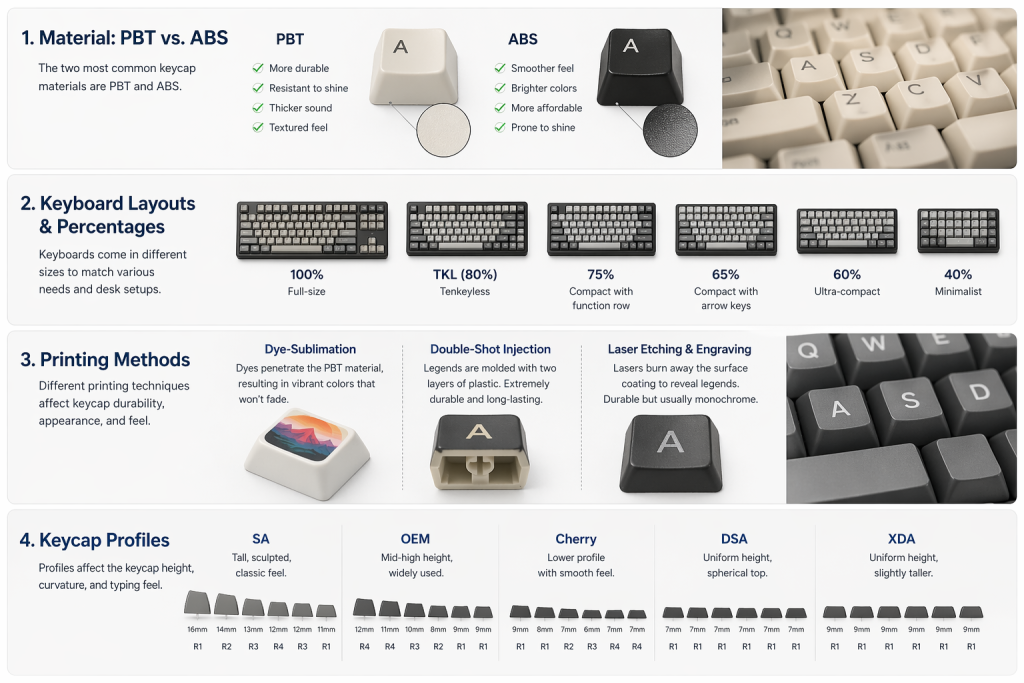
- Material options: PBT, ABS, PC, or specialty resins — each with different texture, durability, and sound characteristics.
- Printing and molding processes: Dye-sublimation for vivid full-color graphics, double-shot injection for legends that never fade, laser engraving for tactile markings, and UV printing for small-batch prototyping.
- Profile tooling: Cherry, OEM, SA, DSA, XDA, KAT, and MOA profiles, with the ability to develop custom sculpts for large orders.
- Layout coverage: Full-size, TKL, 75%, 65%, 60%, and any non-standard layout your design requires.
Step-by-Step: From Idea to Finished Custom Keycap Set
1. Define Your Design Brief
Before reaching out to any manufacturer, clarify the essentials:
- Color palette: Specify Pantone or RAL codes for exact color matching.
- Legend style: Text only, icons, sublegends, or novelties?
- Profile and material: Cherry-profile PBT is the most popular starting point for a custom keycap set, but your choice depends on the typing feel, sound, and budget you’re targeting.
- Quantity: Most keycap OEM manufacturers set minimum order quantities (MOQs) between 50 and 500 sets for dye-sub PBT. Double-shot ABS typically requires higher MOQs due to tooling costs.
Having a clear brief saves rounds of back-and-forth and helps the factory quote accurately.
2. Choose the Right Manufacturing Partner
Not all factories are equal. Evaluate potential keycap OEM manufacturers on these criteria:
| Factor | What to Look For |
|---|---|
| Process capability | Does the factory support your required printing method and profile? |
| Sample quality | Request physical samples — check legend sharpness, color accuracy, and surface finish. |
| MOQ flexibility | Can they accommodate your volume, especially for a first run? |
| Communication | Do they respond within 24–48 hours? Can they work in English? |
| Lead time | Typical production takes 3–6 weeks after sample approval. Confirm realistic timelines. |
| Certifications | Look for ISO 9001 or equivalent quality management systems. |
Ask for a portfolio of past custom keycap projects. A manufacturer that has produced sets for well-known group buys or brands will understand the quality standards the community expects.
3. Request Samples and Iterate
Once you’ve shortlisted a factory, send your design files and request a sample run. Most manufacturers accept AI, PSD, or SVG files for dye-sublimation artwork.
During the sample stage, check:
- Color consistency across modifier keys, alphas, and accent keys.
- Legend alignment — misaligned or blurry legends are deal-breakers for keyboard enthusiasts.
- Stem fitment — test the keycaps on Cherry MX, Gateron, and Kailh switches to confirm compatibility.
- Surface texture — PBT should feel slightly grainy; ABS should be smooth without visible mold lines.
Don’t hesitate to request revisions. A reliable keycap OEM manufacturer will welcome feedback — it’s far cheaper to fix a sample than a full production batch.
4. Approve and Produce
After sample approval, confirm the production order in writing. Lock down:
- Final quantity and packaging requirements
- Pantone references and material specifications
- Delivery timeline and shipping method (sea freight for large orders, air express for small batches)
- Quality inspection terms — many buyers request an AQL (Acceptable Quality Level) check before shipment
Production for a standard custom keycap set typically takes 20–40 days depending on complexity and order size.
5. Quality Control and Delivery
Before the shipment leaves the factory, conduct or arrange a final inspection:
- Visual check: Random sampling for legend defects, color drift, and surface blemishes.
- Functional check: Stem tightness, keycap height uniformity, and profile accuracy.
- Packaging: Ensure keycaps are sorted by row and protected against scratches during transit.
Common Mistakes to Avoid
- Skipping physical samples: Screen colors and real keycap colors can differ dramatically. Always verify with a physical sample.
- Ignoring MOQ realities: Ordering below MOQ often means higher per-unit costs or longer lead times. Plan your quantities around the factory’s sweet spot.
- Vague color specs: “Blue” means nothing without a Pantone code. Ambiguity leads to disappointment.
- Rushing timelines: Quality custom keycaps take time. Factories that promise unrealistic turnarounds may cut corners on QC.
Who Needs a Custom Keycap Set?
Custom keycaps aren’t just for hobbyists running group buys. The market has expanded to include:
- Keyboard brands launching signature colorways with their boards.
- Esports organizations creating team-branded peripherals.
- Tech companies ordering branded keycap sets as premium employee or client gifts.
- Content creators and streamers designing merch that resonates with their audience.
- Designers and developers building ergonomic setups with keycaps that match their workflow (Mac layouts, shortcut legends, etc.).
If any of these sound like you, partnering with a dedicated keycap OEM manufacturer is the fastest path from concept to your desk.
Ready to Start Your Custom Keycap Project?
Creating a custom keycap set is more accessible than ever — but the result depends heavily on the manufacturer you choose. Look for a partner with proven experience, transparent communication, and the willingness to get the details right.
If you’re planning a custom keycap project and want to discuss materials, processes, or get a quote, get in touch with us. We’d love to help bring your design to life.
Read following post to learn how to customize your keycap design:
Recommended mechanical keyboard keycap
-

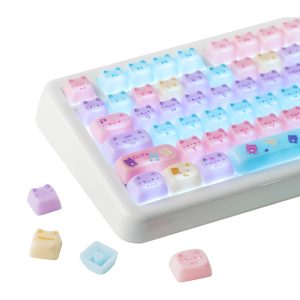
Cute Cat Pudding Keycaps Translucent for Mechanical Keyboards
Price range: $47.00 through $780.00 -
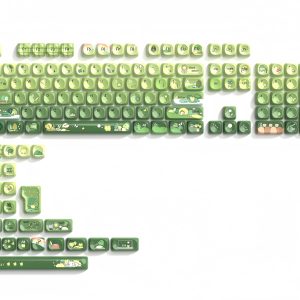
Green Cute Frog Mechanical Keyboard Keycaps PBT 132-Key Dye-Sublimated MOA Profile Rainy Lotus Pond
Price range: $28.90 through $240.00 -
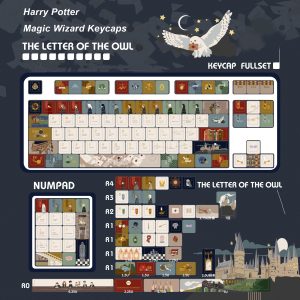
Harry Potter Wizard Theme PBT Keycaps Dye-Sublimation for Mechanical Keyboards
Price range: $46.00 through $1,280.00 -
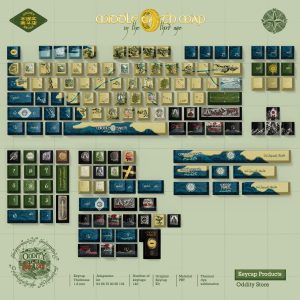
Lord of the Rings Keycaps Set 140 Keys for Mechanical Keyboard
Price range: $79.00 through $1,480.00 -
Pokemon Keycaps Set 131-Key PBT Cherry Profile Dye-Sub Backlit Keycaps
$33.90 -
Wholesale Grey Transparent Keycaps – 115-Key MDA Profile Shine-Through Set
Price range: $19.00 through $760.00